+1 (212) 382-1314

Alexandrite continues to cement its reputation as one of the world's rarest and most fascinating colored gemstones. During the first half of 2026, several important auction houses offered exceptional alexandrites ranging from just over four carats to more than twenty carats. The results demonstrate an important lesson that every collector, investor, jeweler, and gem enthusiast should understand.
There is no universal price per carat for alexandrite.
Instead, origin, color, degree of color change, rarity, cutting quality, clarity, certification, and overall beauty all combine to determine value. Two alexandrites that appear similar on paper can sell for dramatically different prices.
Four significant auction results from 2026 to explain why:
Important Note: This analysis is based on publicly available auction descriptions, laboratory reports, and photographs. I did not inspect any of these gemstones in person. Viewing an alexandrite under controlled lighting is critical, and subtle differences in color, brilliance, transparency, and color change often become apparent only during physical examination. Therefore, the observations below should be viewed as informed market commentary rather than definitive grading.
Christie's – June 9, 2026
Price Realized: $482,600 USD
Price Per Carat: Approximately $32,740 per carat
Specifications
Weight: 14.74 carats
Origin: Brazil
Shape: Oval Mixed Cut
Treatment: None
Laboratory: AGL
Degree of Color Change: Prominent (90–100%)
Quality of Color Change: Excellent


This was unquestionably one of the finest alexandrites offered publicly during the first half of 2026.
The AGL report awarded the gemstone one of the highest possible color-change grades, with Prominent (90–100%) color change and Excellent quality of color change. Those two characteristics alone place the gem into an elite category.
Just as impressive is the size.
Finding a natural untreated Brazilian alexandrite approaching fifteen carats is extraordinarily rare. Stones of this size seldom appear on the public market.
The daylight color appears to be a rich blue-green, while the incandescent color shifts to a vivid purplish-red.
One point worth discussing is the daylight color.
Many collectors assume that "more blue" automatically means better. In reality, that is not always the case. Traditional collectors generally prefer alexandrites that display a strong green component in daylight. Blue-green is often considered slightly rarer than pure green, but an overly blue stone can sometimes appear darker and lose brightness. This example appears to balance both exceptionally well.
The cutting also deserves recognition.
Based solely on the published photographs, the cutter minimized noticeable windowing while preserving the face-up size. Larger alexandrites often require compromises between weight retention and brilliance. This stone appears to achieve both.
It is easy to understand why bidders pushed this piece to nearly half a million dollars.
Christie's – May 29, 2026
Approximately $65,000 USD
Price Per Carat: Approximately $15,700 per carat
Specifications
Weight: 4.14 carats
Origin: Brazil
Shape: Oval
Treatment: None
Laboratories: SSEF and GIA
Daylight Color: Purplish Blue (SSEF), Greenish Blue (GIA)
Incandescent Color: Purple
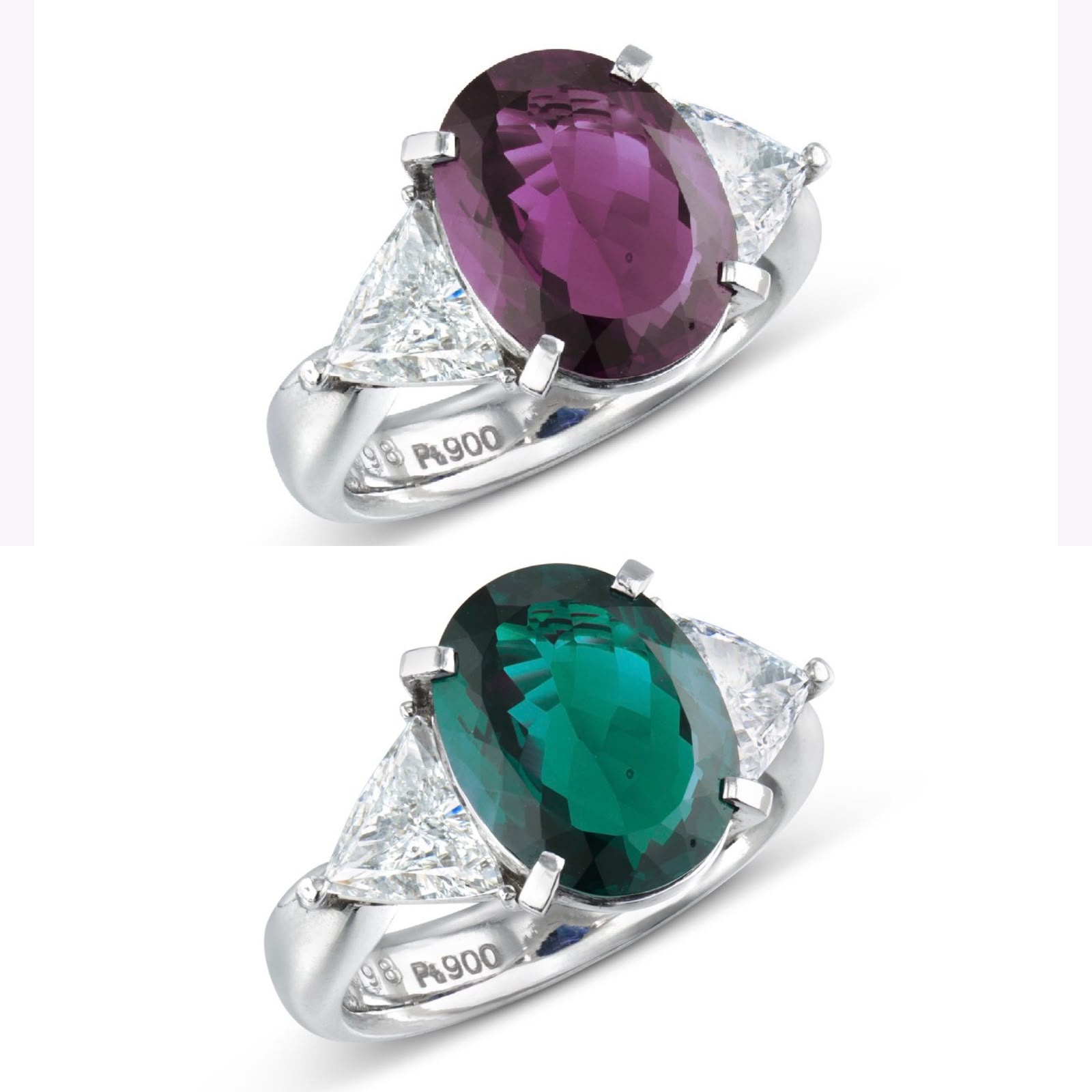

Although this gemstone sold for far less than the 14.74 carat example, it remains an excellent Brazilian alexandrite.
The first thing that stands out is the certification.
Having reports from both SSEF and GIA adds tremendous confidence for buyers. Multiple respected laboratories help confirm origin and treatment status, particularly for high-value gemstones.
The stone exhibits a distinct color change from purplish blue or greenish blue to purple.
This raises an interesting discussion.
From a rarity perspective, collectors generally prize alexandrites with a stronger green component in daylight. Once the daylight appearance shifts heavily toward blue, the stone may lose some of the classic emerald-like appearance that has historically defined fine alexandrite.
Again, this is not necessarily better or worse. It simply represents a different appearance.
The photographs also suggest a modest window through the center of the stone. While impossible to confirm without examining the gem in person, windowing can reduce face-up color intensity and brilliance, which may influence bidding.
Even so, a four-carat untreated Brazilian alexandrite with dual certification remains exceptionally rare.
Sotheby's – June 18, 2026
Price Realized: $51,200 USD
Price Per Carat: Approximately $8,190 per carat
Specifications
Weight: 6.25 carats
Origin: India (Orissa)
Shape: Oval
Treatment: None
Laboratories: AGL and Gübelin
Degree of Color Change: Prominent to Strong
Quality of Color Change: Excellent to Very Good

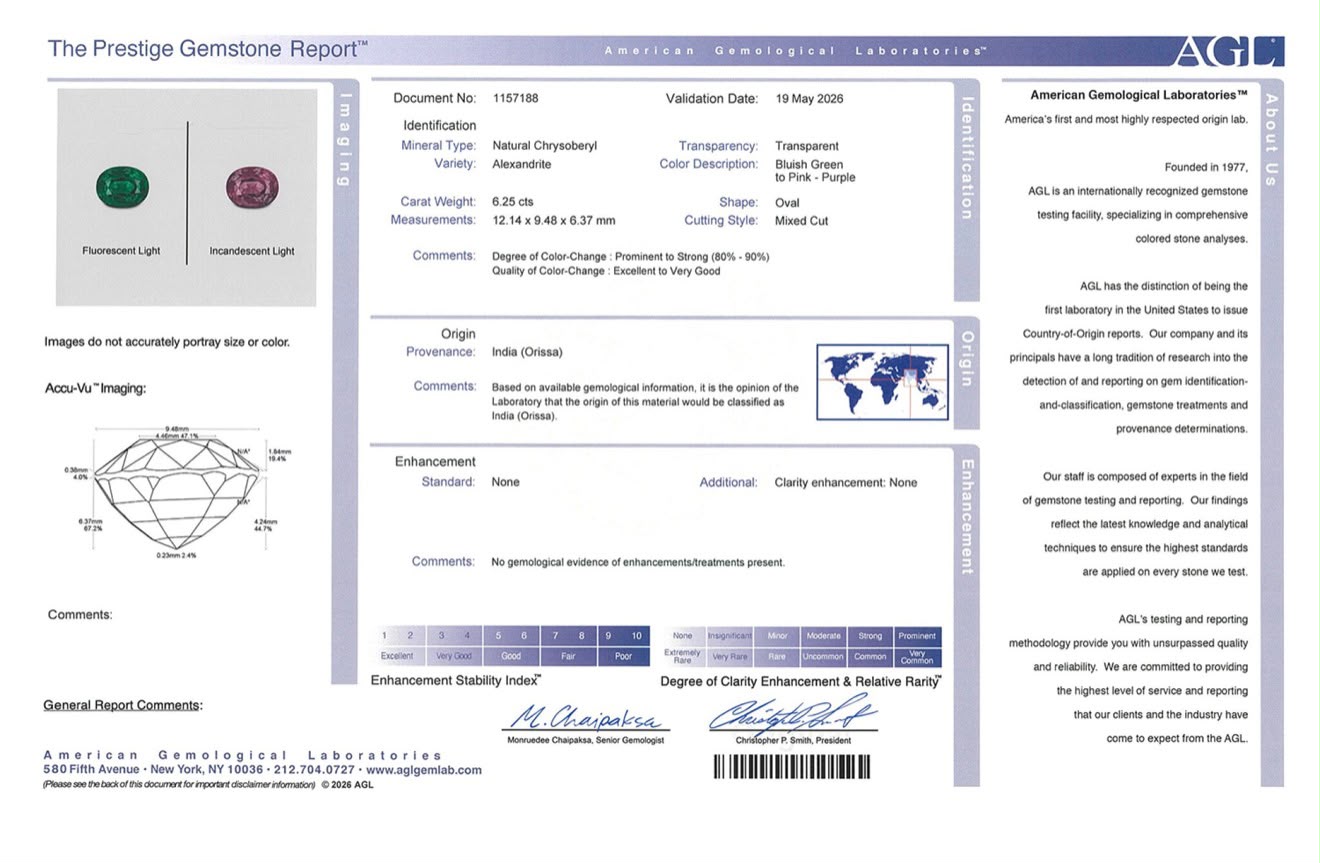
This sale illustrates an important principle in alexandrite pricing.
Larger size alone does not guarantee a higher price per carat.
The gemstone carries excellent laboratory documentation from both AGL and Gübelin. It also received strong grades for color change.
However, Indian alexandrites occupy a different place in today's collector market than Brazilian material.
Brazilian alexandrites generally command stronger premiums because of their historical reputation for vivid daylight color combined with dramatic color change.
The photographs also suggest that this gemstone displays a deeper tone, which may slightly reduce overall brightness.
It is still an impressive untreated six-carat alexandrite, but collectors appear to have assigned a lower price per carat compared with similarly certified Brazilian stones.
Sotheby's – May 14, 2026
Price Realized: 61,440 CHF
Approximately $75,000 USD
Price Per Carat: Approximately $3,640 per carat
Specifications
Weight: 20.61 carats
Origin: East Africa
Shape: Oval
Treatment: None
Laboratory: AGL
Degree of Color Change: Strong to Moderate
Quality of Color Change: Good


This was the largest gemstone in the group, yet it realized the lowest price per carat.
Why?
The answer lies in rarity—not size alone.
Unlike the Brazilian examples, the AGL report describes a daylight color of brownish yellowish green shifting to brown-pink. The report also grades the color change as Strong to Moderate, with an overall quality of Good rather than Excellent.
Collectors place enormous importance on daylight color and strength of change at that size.
Most buyers seek vibrant green or blue-green hues. Once brown becomes a dominant component, desirability generally decreases, even in exceptionally large stones.
The photographs also suggest noticeable windowing through the center of the gem. Again, this cannot be confirmed without inspecting the stone in person, but if present, windowing reduces color saturation and brilliance when viewed face-up.
Despite weighing more than twenty carats, the market clearly discounted the stone because rarity is determined by quality, not simply by weight.
What These Four Auction Results Teach Us About Alexandrite Prices
These sales reinforce several important principles that apply to the alexandrite market.
First, origin matters. Brazilian alexandrites continue to command significant premiums because of their exceptional combination of color and rarity. Historically, collectors have associated quality with this origin, but its important not to assume quality automatically follows origin. As a matter of course, a gem should always be judged on its own merits regardless of birth country.
Second, color change remains king. Buyers consistently reward stones with intense transformation under incandescent light.
Third, laboratory reports matter. Reports from respected laboratories such as AGL, GIA, SSEF, and Gübelin increase buyer confidence, especially when multiple reports confirm the same origin and treatment status.
Fourth, cutting influences value. Even a rare gemstone can lose value if excessive windowing allows light to pass straight through the center rather than reflecting back to the viewer. A well-proportioned cut enhances brightness, saturation, and face-up appearance. Its worth noting that the alexandrites that fetched higher prices were mounted in rings, and not loose gemstones!
Finally, size amplifies rarity—but only when paired with outstanding quality. A fifteen-carat Brazilian alexandrite with exceptional color change is exponentially rarer than a twenty-carat stone with average color. The auction results clearly demonstrate that collectors pay premiums for the complete package, not just for carat weight.
As the alexandrite market continues to mature, I believe buyers will become even more educated. They will increasingly evaluate gemstones based on measurable quality factors rather than size alone. For collectors and investors alike, understanding these characteristics is essential to making informed purchasing decisions.


.svg)